


















At the beginning of February 2022, the price of coffee was at its highest in eleven years. What were the reasons for this? Who benefits and who doesn't? And will coffee prices continue to rise? We take a closer look.
About six months ago, roasters and retailers began to raise the prices of roasted coffee. These price increases are actually price adjustments, as the raw material, green coffee, in particular became massively more expensive. There are several reasons for this, but it all began with the Covid pandemic.
Coffee Price Surge - It Began with Covid-19
Do you remember the delivery delays at the beginning of the pandemic? We all suddenly had to wait a few weeks instead of just a few days for a shipment to arrive. This primarily affected suppliers first, and then private individuals. Weeks turned into months, and after just one year of the pandemic, the logistics world was in the deepest chaos it had ever seen.
I blogged about this here: it's about force majeure, acts of God - once-in-a-century events that rarely occur, and when they do, they shake everything up.

For example, we are still waiting for a green coffee shipment that should have arrived three months ago. Other shipments are also massively delayed, or even completely cancelled.
It all started when, shortly after the first lockdowns, too many ships were in one place and too few in another. This led to congestion at the world's largest ports - on the water and on land with trucks. Within a very short time, a disbalance developed that logisticians had never seen before.
But why did coffee become so much more expensive now?
Reason 1: Logistics Costs
Against this backdrop, the price for a freight container rose massively. Anyone who wanted to transport had to pay more and more.

The Global Container Index from https://fbx.freightos.com/ clearly shows how freight rates for a shipping container have developed. A tenfold increase in costs is no longer a rarity. For the same container and the same route, mind you.
A container transport (20 feet) from Peru to Europe cost about 1200 USD just over two years ago - today it costs almost ten times as much. The large shipping companies in particular are benefiting from this. Maersk's share price, for example, has risen by 200% in the last two years.
A well-oiled machine was severely disrupted.
A cargo ship can hold up to 20,000 containers. If only ten ships are off schedule, 200,000 shipping containers are missing worldwide. That's enough to throw a delicately balanced system into disarray. And that's what happened. The port of Los Angeles experienced the biggest offshore backlog in American shipping history.
Reason 2: The Frost in Brazil
And then, on July 1, 2021, there was frost in large parts of Minas Gerais. In one night, temperatures dropped to -1.2°C, which was enough to destroy entire tracts of plants. Within two weeks, the coffee price rose again by a good 60 cents per pound (lb).

Screenshot showing the price development in July 2021.
However, no one yet knew how exactly to quantify the damage. Now, as the harvest in Brazil slowly begins, it will become clear whether the estimates of up to 30% crop failure were correct, or, let's say, justified. Justified, because coffee is an extremely volatile market, shaped by sensitive forces. When there are signs of a crop failure, the first estimates come in, speculation occurs on the futures market, and prices quickly rise - even though everything so far is not confirmed knowledge, but only assumptions.
Only now is it slowly becoming clear that the total amount of damage is significantly less than expected. In specific areas, however, producers have been hit hard, and most of the harvest has simply frozen.
The coffee exchange reference price, the so-called C-Price, therefore rose again massively within a very short time. Already then, or shortly before, the first coffee roasters had increased their prices, including Tchibo. It became obvious how trading houses and roasters had become accustomed to an extremely low price level, so that they already increased the sales prices for roasted coffee with the first price increase in June 2021. A second increase then followed in February 2022.
Since the price of coffee is subject to classic supply-and-demand dynamics, the C-Price rose. All other coffees with so-called differentials are also based on the C-Price. A differential is a premium (or discount) on the C-Price, which is levied according to quality and, again, supply and demand.
For example, there is a good market for washed green coffee from Guatemala; the coffees are in demand, the quantity is limited - this is reflected in the differential, so that this coffee always runs about 30 cts/lb above the C-Price.
Even if a coffee producer in Malaysia has nothing in common with a producer in Brazil, they are still compared by the C-Price. Locally, the differential then comes into play and rewards, or punishes, the coffee somewhat.
Reason 3: Everything Out of Joint
Uncertainties are the speculator's bane. Speculation in the coffee market amplifies the upward or downward impulse even more. And speculation increases especially when uncertainties exist, and these have been steadily increasing for more than two years now.

However far a coffee farm may be from the events on the New York Stock Exchange, the effects are immediately noticeable.
In Colombia, riots broke out in 2021, and ports were closed for weeks. In Brazil and Vietnam, there were trucker strikes, which severely disrupted inland logistics. War rages in northern Ethiopia, La Niña in Indonesia, and Central America experienced a prolonged drought.
The only constant in coffee is its inconsistency.
These uncertainties have always existed in the coffee industry, but they have recently been perceived with greater sensitivity, leading to more unrest and speculation. These gave coffee prices a further impulse to soar.
Reason 4: Covid-19 in the Coffee Regions
Covid itself has hit many coffee regions extremely hard. We must not forget: most coffee-producing countries are developing countries. Basic medical care is often slow, not widely available, or very radical.
We heard various anecdotes from our partner producers:
- Pickers stay home because they fear infection
- this led to less internal migration of pickers who would have worked as seasonal laborers in the coffee regions
So, the wages for pickers had to be raised just to find someone to harvest coffee cherries. But: if prices are high, pickers don't even have to bother picking good quality, unless they are paid even more. And that's the case with specialty coffee - all coffee becomes more expensive, but specialty coffee even more so.

If you want good quality, you currently have to pay significantly more than before.
Benni Distl from Rancho San Felipe in Mexico told me:
I paid twice as much as last year, but the pickers barely come anyway. Some say the same money for half the work.
The Homo Economicus approach may work for some people here, but not in other parts of the world.
Reason 5: Higher Interest Rates for Coffee Farms
And then, due to all these uncertainties, interest rates on loans also became more expensive. Loans that coffee producers need long before the harvest to constantly invest in new plants, cover fixed costs, and pay personnel. Coffee farms typically earn money once a year - when the coffee is sold.
However, cash is constantly needed; a coffee farm is essentially a business that must function like any other. But interest rates for this type of business have risen massively. In Peru, according to Mark Bolliger, interest rates rose from 15% to 21% within a few months.
Reason 6: Higher Costs for Fertilizer, Diesel, and Living (Inflation)
Russia is the world's largest exporter of fertilizer, while Brazil is the largest buyer of that same fertilizer. Brazil is also the largest coffee producer worldwide, with a share of approximately 33%. Coffee producers also use Russian fertilizer, and so inland prices for Brazilian coffee have risen again in recent weeks. And because price changes in Brazil also have global impacts, this affects other coffee-producing countries.

Accurate accounting is currently important for everyone. However, many coffee producers have little insight into their production costs.
Besides fertilizer, fuel has also become significantly more expensive, which we feel here too. Fuel is needed on farms, but shipping in particular is heavily affected by it, which keeps logistics costs high.
And then the whole world is feeling inflation. Just this week, I paid two francs more than usual for a falafel - the oil had become more expensive, as had the bread. The latter will probably become even more expensive, as Ukraine and Russia are also among the largest exporters of grain.
No Exchange Coffee, Yet Still More Expensive
So, there are several reasons and effects that have driven up the price of green coffee. Even if we do not base our pricing on the exchange price, we are still influenced by it. The prices for our green coffees are in most cases defined by the producers themselves. In addition, there are the costs for further processing, export, transport, pre-financing, insurance, and storage.
Producers are influenced by all the reasons mentioned above. The C-Price rose sharply last July within a short period because two nights of frost in Brazil threatened a substantial part of the harvest. Producers also see these developments and sell "slower," meaning they do not yet sell the already harvested coffee, or the coffee soon to be harvested. They wait, as the coffee price may continue to rise, and they would then earn more from selling the cherries.

Coffee is currently being hoarded by producers before being resold.
Coffee producers have always been price-takers and not price-makers, as Raphael Studer also clarified in this podcast.
I take what the market gives me.
Producers have been conditioned this way for decades. It is only logical that this mechanism continues to exist now, especially if it is developing in favor of the producers.
Not Everyone Is Earning More Now
And yet, just because prices are higher doesn't automatically mean everyone earns more. The reasons mentioned above show that everything has become more expensive, not just green coffee. Some producers may still benefit, especially those who are very efficiently organized.
In Dipilto, northern Nicaragua, however, a different picture emerges, which is not uncommon. Many pickers are leaving the region, farm work is becoming less and less attractive, and life is getting more expensive. Farms are desperately looking for workers and have to pay day laborers wages that were unimaginable two years ago.
The long-term effects of this recent price rally on the coffee production side still need to be analyzed to get a more accurate picture of winners and losers.
Who is earning more now?
Shipping companies certainly. The bottleneck is manifesting in logistics. There is no alternative to shipping - at least not a faster or cheaper one. Transport by sailing ships will increase in the future, but it will be a long time before this share becomes substantial.
Trading houses, roasters, retailers, cafes - all players at the end of the coffee chain initially gave up some margin, but now have to adjust prices to cover their costs. The extra cost is passed on to end consumers, and coffee becomes more expensive.
No one knows how long the price will remain so high. But what we do know is that we want to make our green coffee chains and our cooperation with coffee producers much more autonomous. We aim to ensure that, in the best-case scenario, geopolitical events no longer influence how we would like to see coffee production in the future. We will be able to report more on this at the appropriate time.
How much more expensive will our coffees become?
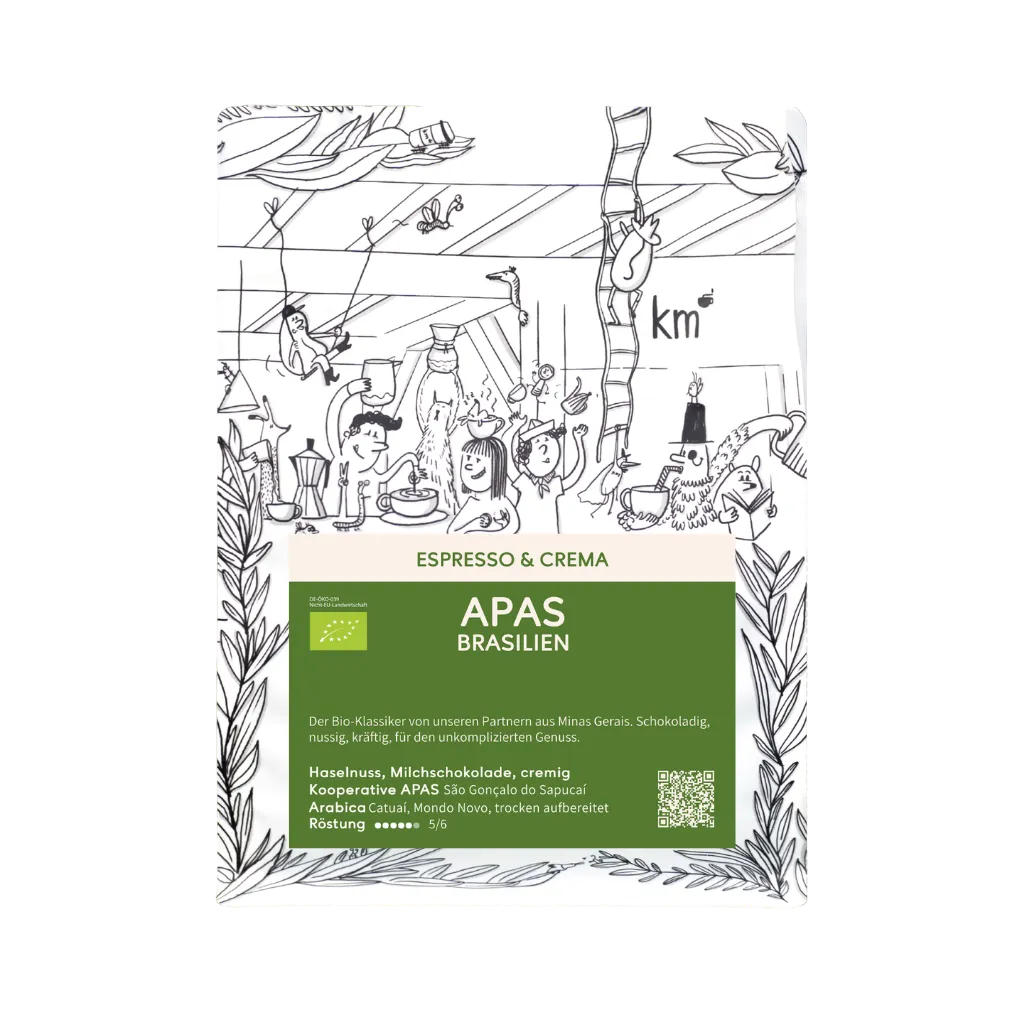
We are moderately adjusting four of our coffees as of May 1, 2022: Henrique, Flhor, Flaneur, and Dreispitz. Even though the green coffee price from the APAS cooperative has almost doubled, we are keeping the APAS at the same price level as before. This coffee is important to us, it's important to you, and we are currently intensively developing our partnership with APAS - more on that later this year. We want to be a reliable partner, buy the promised quantities, and keep the coffee attractive for many.
The Management Summary as a Postcard
In our cafes, shop, and academy, there is now a postcard with compressed information on why coffee is becoming more expensive. It was important to us to understand the current situation precisely and summarize it for you here. You can find the text of the card here.

The last two years have also severely shaken up the coffee industry. The Covid lockdowns have sensitively disrupted the finely oiled machinery of global logistics, and this continues to this day. Delays and massively increased transport costs are the consequences. The pandemic itself continues to leave its mark in many coffee-producing countries - fewer pickers can travel freely, there is an acute shortage of harvest helpers, and the sometimes poorly functioning health systems forced many people to stay at home. Life became more expensive during the pandemic, inflation rose, and in July 2021, there was frost in the southern coffee regions of Brazil. Two nights of frost were enough to potentially wipe out up to 30% of the upcoming harvest. The exchange price continued to rise massively overnight. Although we do not base our pricing with producers on the coffee exchange, we are affected by it: when the global exchange price rises, higher prices can be achieved locally. Producers orient themselves to the so-called C-Price, and delay selling coffee cherries to, for example, the cooperative, which forces them to push up the purchase price. Even for moderate quality, about twice as much is currently paid as two years ago. And that hardly motivates workers to pick more precisely. So, anyone expecting specialty quality must offer even more, as the base price is so high. Rising raw material prices, including for fertilizer, are doing the rest, keeping the price very high. And who benefits from this? Above all, the shipping companies, who are currently in high demand. Some producers can also benefit, after the coffee price barely or did not cover production costs for the last ten years. We ourselves have gained efficiency with the new roastery, which allows us to adjust roasted coffee prices only slightly.


